What to send for sample processing
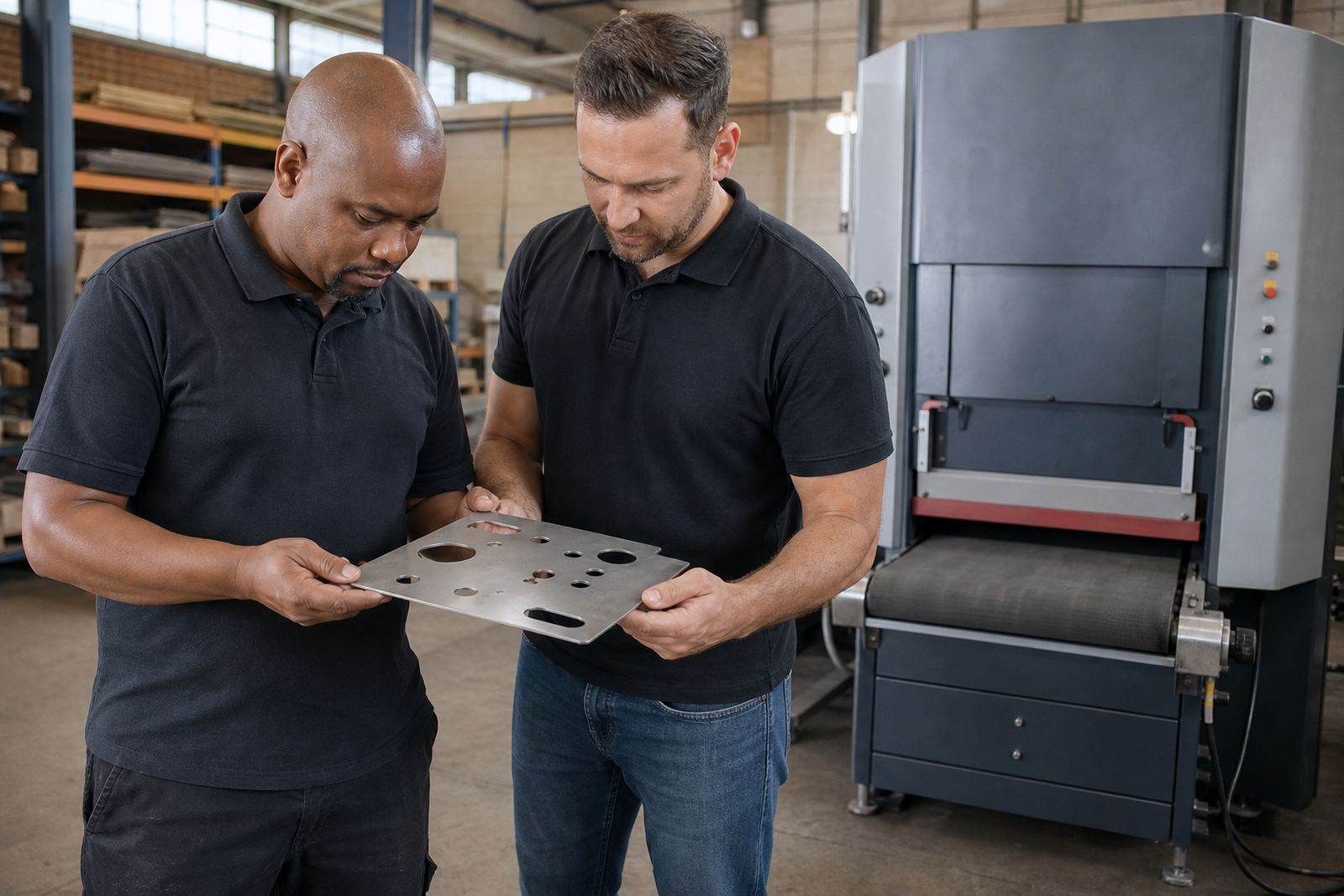
Send parts that reflect the work you actually run on the shop floor. The best samples are laser-cut sheet metal pieces with the same thickness, alloy, holes, slots and edge conditions you see in daily production. If you process mild steel, stainless steel or aluminium, send a representative part for each material type so the finish can be checked properly.
Please include enough pieces to show variation. One clean part tells part of the story, but a small batch helps us see how the machine handles burrs, edge scaling and any slight warping from cutting. If the parts are going into a specific assembly, send one or two extra pieces as back-up.
- Laser-cut sheet metal parts from your normal production run
- At least one part per material and thickness
- Parts with holes, cut-outs, internal corners or tight profiles
- Any parts that already show the finish problem you want to solve
How to package samples before courier or drop-off
Pack the parts so they arrive in the same condition they left your factory. Sharp edges can mark other parts in transit, and polished or coated surfaces can scratch if they rub together. Use a sturdy box, thick paper between parts and enough protection to stop movement. If your parts are oily or have loose slag, wipe off what you can before packing.
Label the box clearly with your company name, contact person and the material type. If the sample set has different thicknesses or finishes, group them separately inside the box. This makes the trial faster and avoids confusion when we start the test run.
- Wrap or separate each part to prevent rubbing
- Use a rigid carton or crate for heavier items
- Mark the outside with the material type and quantity
- Include any handling notes, such as delicate faces or coated sides
Information to include with every sample
A good sample is easier to assess when we know what you need from the finish. Tell us what machine or process the parts must suit, whether the parts are for welding, assembly, painting or direct fitment, and what edge quality you expect. If a burr is causing problems on gloves, jigs or machine feed systems, mention that as well.
Please include the basics below so we can set up the trial correctly and give you feedback that is useful on the shop floor.
- Company name and contact person
- Material type and sheet thickness
- Quantity of parts sent
- Current problem or finish requirement
- Whether the parts are for mild steel, stainless steel or aluminium
- Any production target, such as faster cycle time or reduced manual finishing
What happens when your sample arrives at Wadeville
Once the sample parts reach our Wadeville, Germiston base, they are logged and checked for the work requested. We then test the parts on suitable deburring and edge-finishing equipment and assess the result against your expected finish. Where needed, we also check abrasive wear, edge consistency and how the part handles after processing.
If you send parts from Johannesburg, Pretoria, Durban, Cape Town or Rustenburg, we handle the process in the same practical way. We look at the part itself first, then match the trial to the material and the production output you need. If the sample reveals a process issue, we will flag it early so you do not buy a machine on guesswork.
How we assess finish quality and process fit
We do not judge a sample on looks alone. The real question is whether the machine can remove burrs, soften the edge and keep the part usable for the next stage without overworking the metal. Some jobs need a light edge break only, while others need more aggressive finishing before welding, handling or coating.
During the trial we look at repeatability, finish uniformity and how the machine behaves on your exact part type. If a sample shows varying burr heights or awkward internal edges, we will note that too. That helps us recommend the right setup, abrasive type and operating approach for your line. For high-volume shops, even a small change in finish can save a lot of rework over a month.
Getting the most useful result from your trial
If you want the sample test to answer a specific production question, say so upfront. For example, you may need to reduce hand work after laser cutting, improve edge quality before powder coating, or cut down on abrasive consumption. The clearer your target, the better the trial result will be for your team.
It also helps to send parts that are not ideal only in the way you want tested. If the whole sheet is badly cut, the result may not show the normal process. A representative part gives a cleaner view of what the machine can do in your plant, and it saves time when comparing options for your factory.
- State the problem you want solved, not only the part type
- Tell us if the parts are for one-off work or ongoing production
- Share any finish standard your team already uses
- Include contact details on the enquiry form so we can come back with the trial outcome