Why edge quality matters before galvanising
Laser-cut parts often arrive with sharp edges, dross and heat affected burrs that seem minor at the cutting stage but cause trouble later. In galvanising, those rough edges can hold ash, trap acid from pre-treatment, and create thin spots where zinc does not wet evenly. If a fabricator is supplying structural brackets, guards, tray plates or service frames, the finish on the edge can influence the final coating more than many teams expect.
The aim is not to over-finish the part. You want enough edge conditioning to remove burrs, reduce sharpness and support an even coating, while still keeping the part within drawing tolerance. That balance matters on parts with tight fit-up, where a heavy grind can change hole size or bracket dimensions and slow down assembly later on.
What to look for after laser cutting
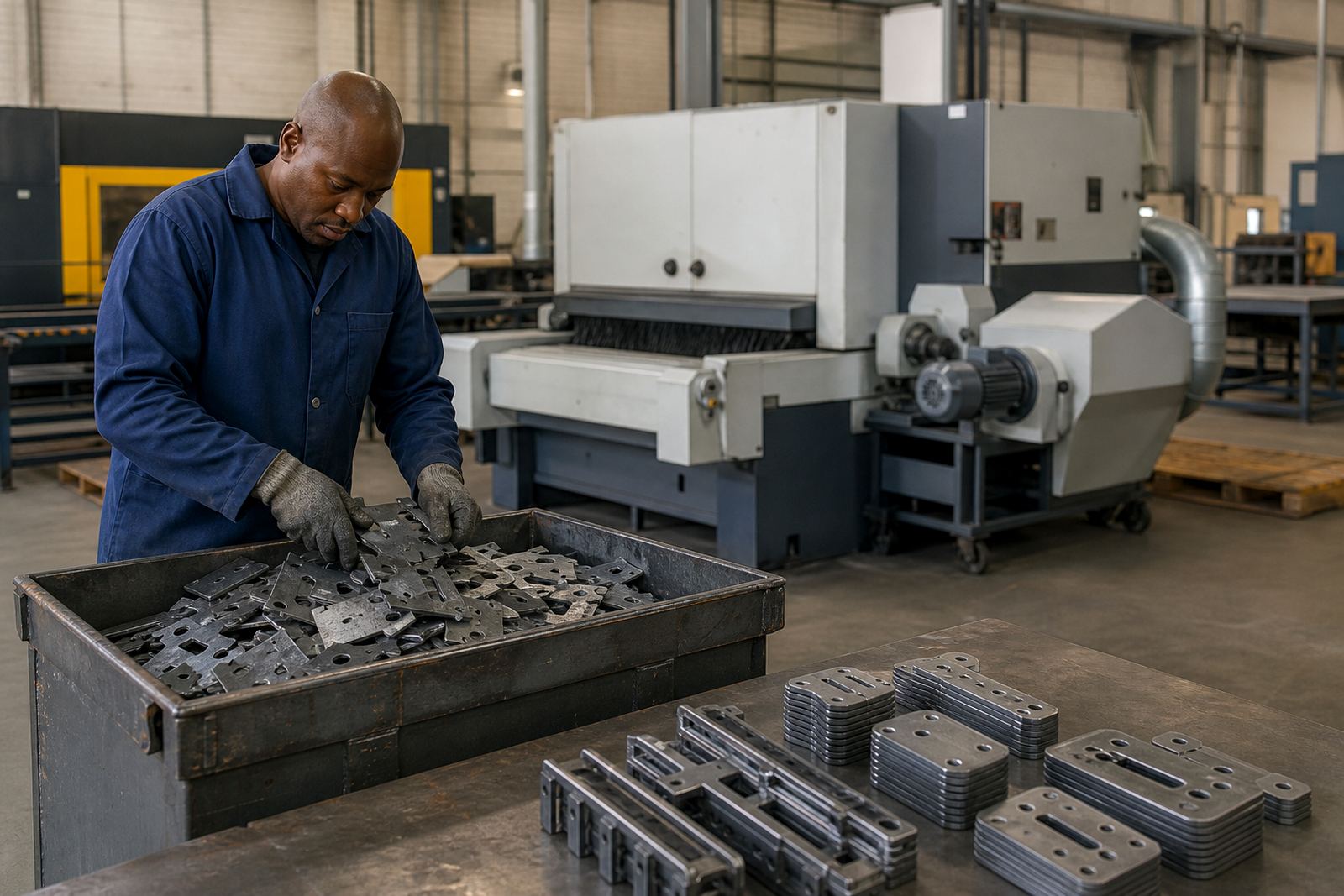
Before parts leave the cutting bay, check whether the burr is on the top edge, underside, or around internal cut-outs. Different burr patterns can point to beam focus, assist gas settings or sheet condition, and that affects how much deburring work is needed. On galvanised work, the real issue is often consistency. One batch may be clean enough, while the next has raised edges on every tab and slot.
- Sharp outer edges that will be handled by fitters or installers
- Dross on the underside that can interfere with coating flow
- Small notches or slots where zinc can bridge or pool
- Threaded holes and tapped areas that may need masking or rework after galvanising
- Heat tint or scale at cut points that should be removed before further processing
Parts that will be welded after galvanising need extra attention as well. Any burr left on a mating face can create poor contact, and that shows up later as weak welds or extra grinding on site.
Choosing the right finish for zinc coating
For galvanising, the target finish is usually a smooth, even edge rather than a polished surface. A light deburr, edge-rounding pass or controlled abrasive finish is often enough. Overworking the face can introduce unnecessary cost and sometimes changes how the part hangs on the galvanising rack. The machine setup should suit the material thickness and the product mix, whether that is 1.6 mm electrical enclosures or heavier 8 mm support plates.
Where drainage and venting are important, the machine process should not close off any holes or distort the geometry. Parts with tubes, folded sections or enclosed spaces need clean openings so that pre-treatment chemicals drain out and molten zinc can flow through properly. If the openings are partially blocked by slag or burr, the galvaniser will usually pick it up and the part may be sent back for correction.
At Deburring, we see that the best results come from process control, not just more machine time. A repeatable setup means the first part and the hundredth part look much the same, which is what production teams need when they are feeding a galvanising line on a tight schedule.
How deburring supports safe handling and fewer rejects
Galvanised parts are often handled multiple times, from cutting to fabrication, then through chemical cleaning, rinsing, drying, galvanising and final packing. Sharp edges increase the risk of cuts and snagging, especially on larger sheet metal assemblies. A proper deburring pass reduces those risks for the people moving the work and lowers the chance of damaging adjacent parts in transit.
- Less rework at the galvaniser because edges are cleaner
- Lower risk of handling injuries in the workshop
- Better fit on assembled parts and bolt-up frames
- Reduced chance of coating defects on corners and burr points
- More predictable turnaround times for urgent jobs
In many South African workshops, galvanising is not the only step waiting on that batch. Paint, assembly and dispatch may all be lined up behind it. A missed burr can hold up the full order, especially when a contractor in Johannesburg needs steelwork out to site before the weekend and nobody wants a delay on Monday morning.
A practical local example from Wadeville to site
A fabricator in Wadeville making outdoor support frames for a Gauteng installation had repeated issues with coating build-up at the corners of small brackets. The parts were laser cut neatly, but the corners still carried a fine burr and some sharp internal edges. After switching to a controlled edge-finishing step before galvanising, the same parts went through the process with fewer touch-ups and less handling damage. The change was small, but it cut down on returns and saved time on the final fit-up.
That kind of improvement matters across South Africa, whether the parts are heading to Pretoria for a municipal job, Durban for a coastal installation, or Rustenburg for an industrial site with heavy wear. Coastal humidity, transport time and on-site handling all put extra pressure on the coating. If the part starts with a poor edge, the rest of the process has to work harder to compensate.
Questions to put to your production team before sending parts out
Before a batch goes for galvanising, it helps to check the process against the final use of the part rather than treating every job the same. A few quick questions can prevent wasted material and avoid rework after coating.
- Are all burrs removed from external edges and internal cut-outs?
- Will the part be bolted, welded or assembled after galvanising?
- Do drain holes and vent holes remain clear after finishing?
- Are the tight tolerance areas protected from over-processing?
- Has sample part testing been done on the first run?
If the answer to any of these is uncertain, it is worth testing a few parts before the full batch goes through. That is usually far cheaper than discovering a problem after hot dip galvanising, when the steel has already been coated and the schedule is under pressure.
Building a repeatable process for mixed work
Most fabricators do not run one type of part all day. They move from laser-cut covers to brackets, then to frames and channel sections, each with its own edge condition. A repeatable deburring process helps keep output steady even when the work mix changes. It also makes training easier for operators, because the pass criteria stay clear: clean edge, correct tolerance, and no damage to the sheet.
For workshops in Johannesburg, Pretoria, Durban, Cape Town and Rustenburg, that repeatability is especially useful when production runs are short and turnaround times are tight. Machine installation, operator training, preventive maintenance and annual service contracts all support that consistency, but the real gain comes from matching the finish to the downstream process. For galvanising, that means preparing the part so the coating can form evenly and the job can move without surprise holds. Small detail, big difference sometimes.